I delivered this talk at the Global Women Lead meeting on October 21, 2026. It offered a practical introduction to AI at work, moving from basic vocabulary and a plausible first draft toward better framing, meaningful alternatives, and human judgment. A fictional international initiative made the choices concrete.
MY ROLE
Talk design and delivery, learning sequence, and illustrative demonstration
PROJECT TYPE
Delivered talk · Global Women Lead meeting
TIMEFRAME
October 21, 2026
Selected slides from my talk at the Global Women Lead meeting, October 21, 2026. The international partnership example and AI responses are illustrative.
THE CHALLENGE
Who is doing the thinking?
A fluent AI answer can look ready to use while leaving important assumptions unexamined. I wanted the session to give people a way to ask what they were actually trying to accomplish, what context was missing, whose knowledge could change the answer, and which decisions they still needed to own.
MY APPROACH
How I worked through it.
Begin with something plausible
I used a fictional kickoff meeting involving partners in three countries. A generic request produced a tidy agenda. That gave the audience a concrete starting point to examine: what would they keep, change, or check before using it?
Make room to think before drafting
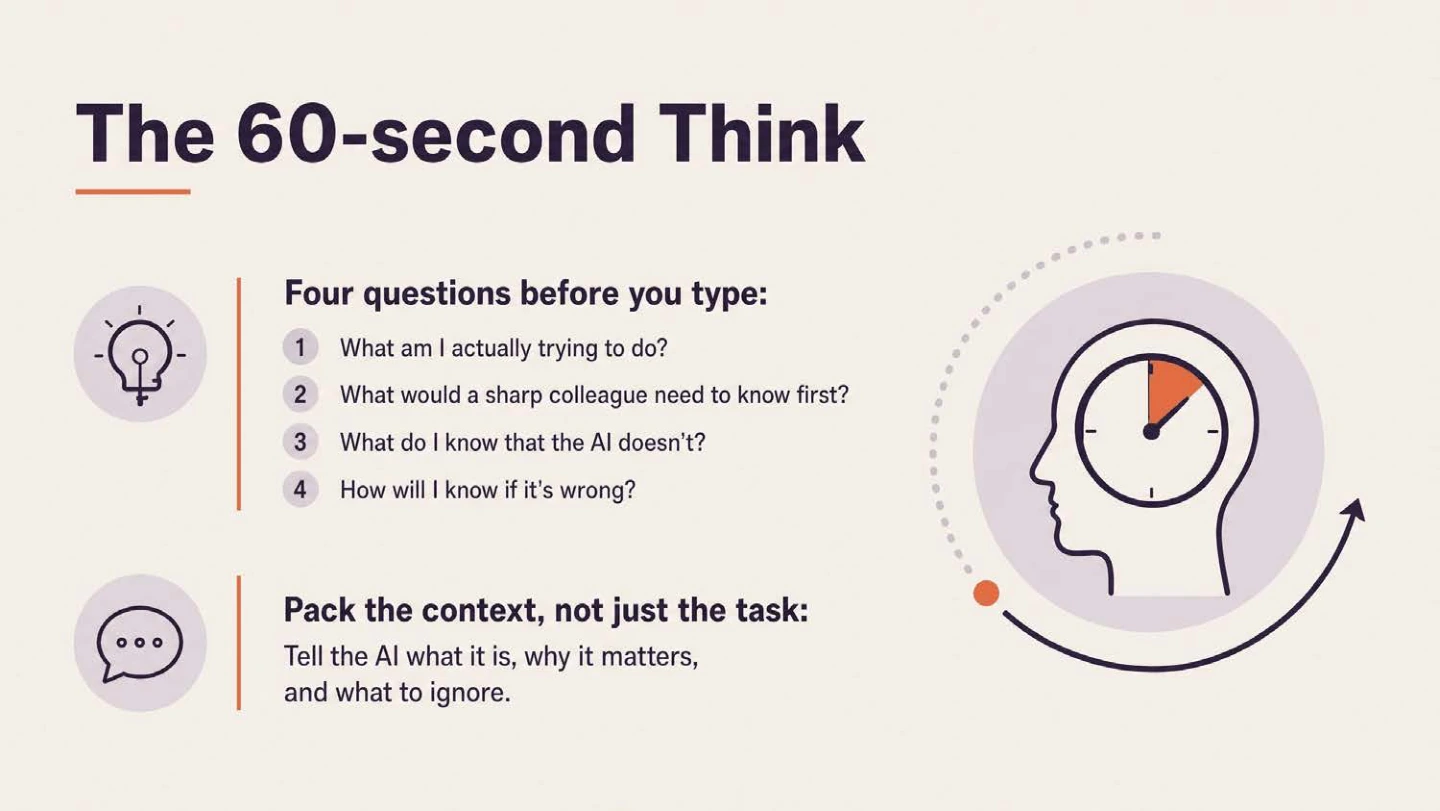
The session introduced augmentation, amplification, and automation, then a short thinking routine: define the goal, identify the context a capable colleague would need, name what the AI does not know, and decide how to recognize a wrong answer.
Return to the example with a different task
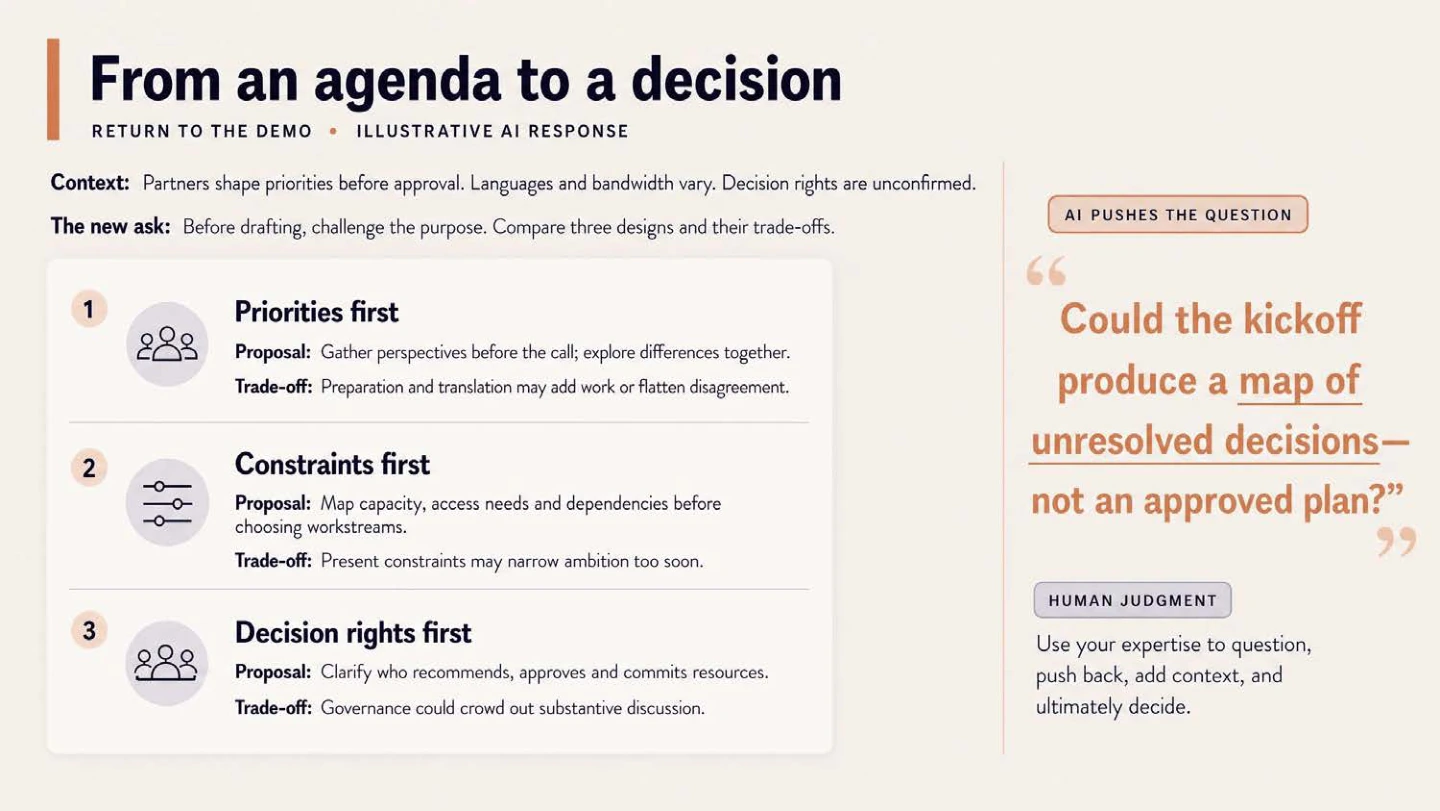
The revised brief asked AI to challenge the meeting's purpose, compare distinct designs, and surface unresolved decisions. It specified that partners must shape priorities, that access conditions vary, and that approval authority is unconfirmed. Those details changed what a useful response could look like.
Examine participation and power
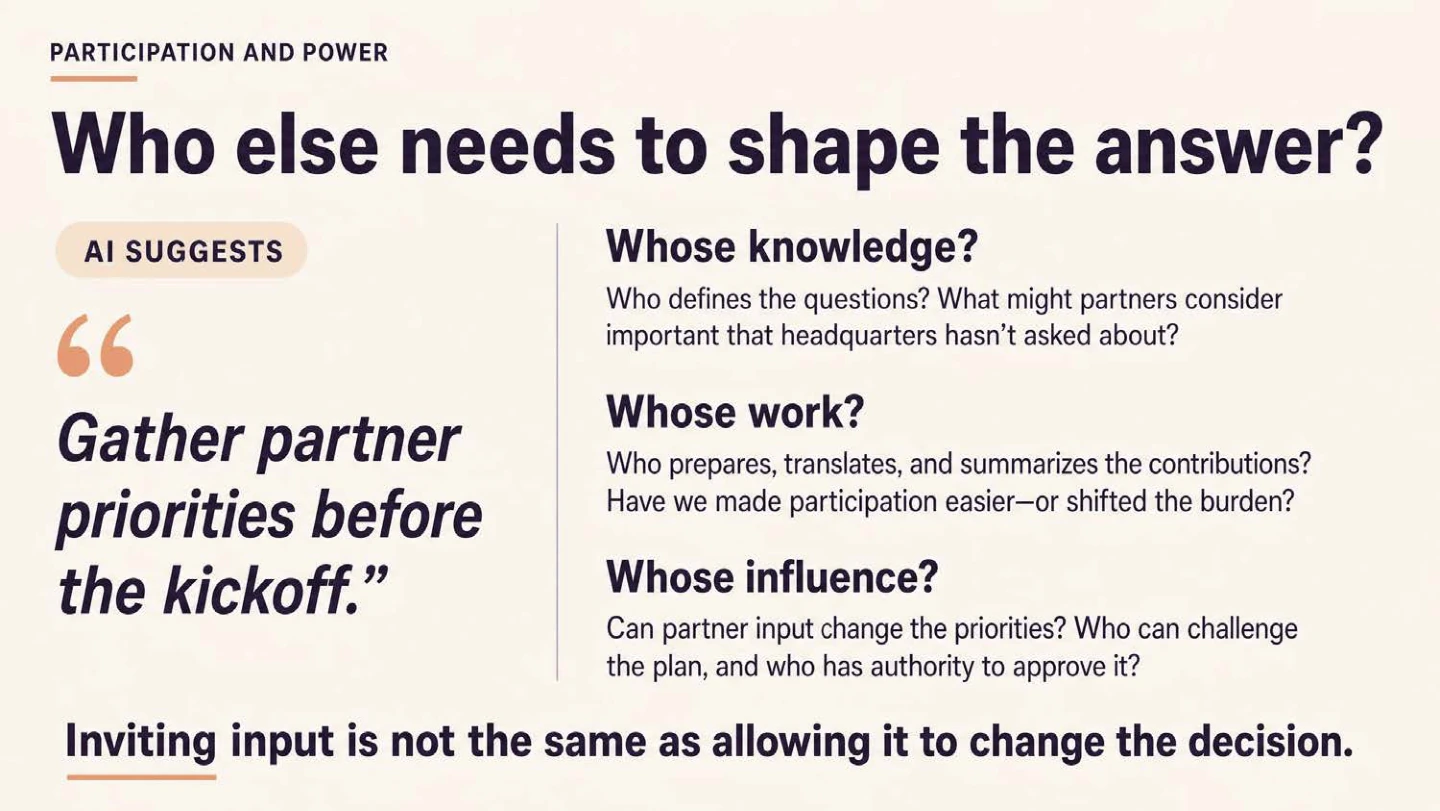
I asked who defines the questions, who prepares and translates the contributions, and whether partner input can change a decision. The example treated preparation, access, and follow-up as real work. It also kept a community's or partner's preferences open for validation.
Close with a bounded experiment
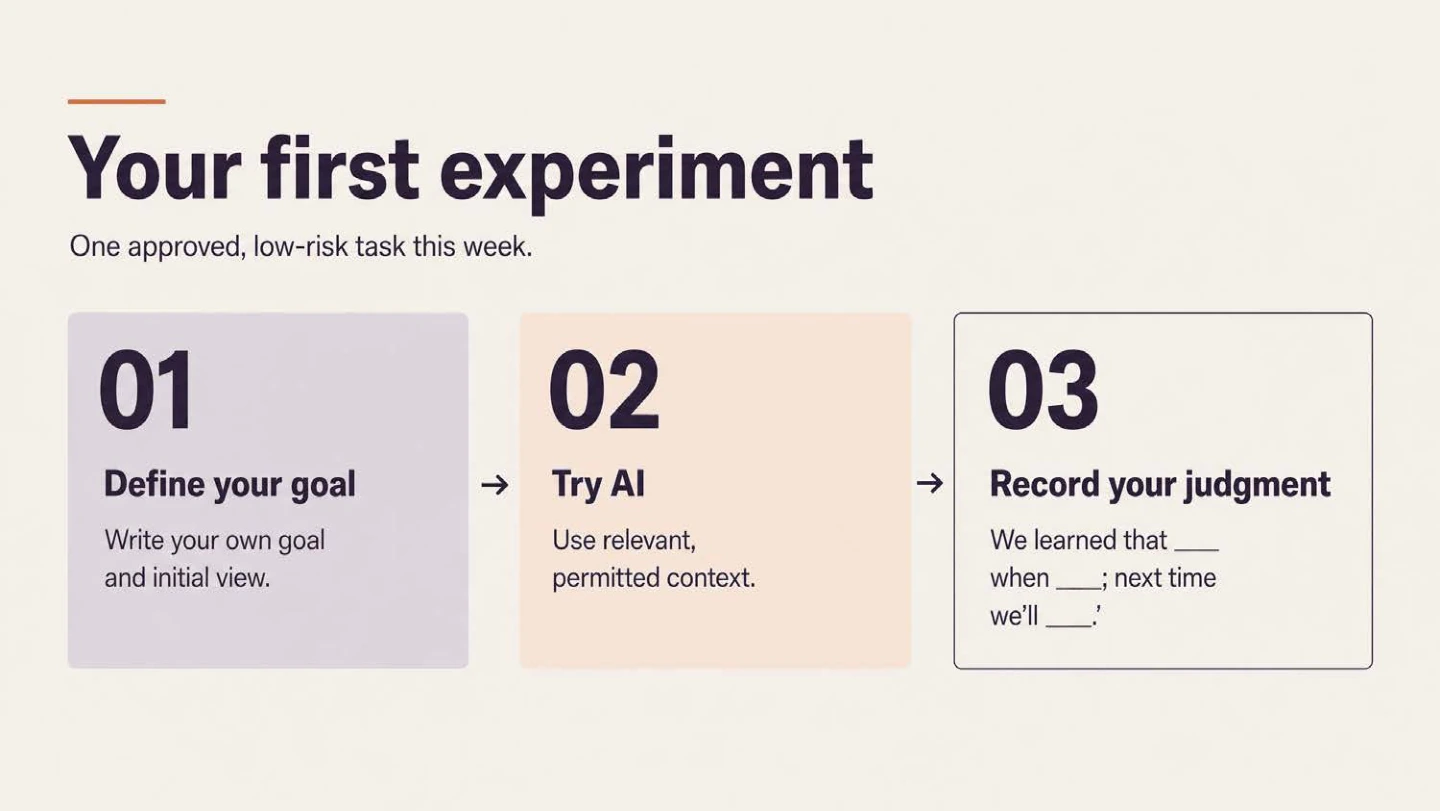
The session ended with six practical ways to use AI on everyday work and an invitation to try one approved, low-risk task. Participants were asked to state their initial view, use permitted context, and record what they learned and would change next time.
DESIGN CHOICES
Where the idea becomes practical.
A fictional example
The international initiative was explicitly illustrative. The prompts instructed the model to distinguish known context from assumptions and avoid inventing country facts, partner preferences, resources, or authority.
Judgment before output
The worked example moved from requesting an agenda to examining the decision the meeting needed to support. Alternatives were compared through trade-offs, participation burdens, and what partners would need to validate.
Practical safeguards
The talk paired invented information, missing context, skewed assumptions, and privacy exposure with useful responses: check claims, supply context, examine missing perspectives, and use approved tools and authorized information.
Capacity with a purpose
The closing questions asked what time and capacity released by AI should make possible, including deeper preparation, more time with partners, and a more manageable workload.
The 60-second Think: clarify the goal, relevant context, missing knowledge, and how to recognize a wrong answer before prompting.Returning to the fictional kickoff: compare meeting designs, expose trade-offs, and leave unresolved decisions open for the people with relevant knowledge and authority.Participation and power: examine whose knowledge shapes the question, who carries the work, and whether contributions can change a decision.A first experiment: define a goal, try AI on an approved low-risk task, and record the judgment and learning that follow.
WHAT I PRODUCED
A contribution you can examine.
I designed and delivered a 19-slide talk with a recurring fictional demonstration, a short thinking routine, practical patterns for everyday work, and a first-experiment structure. The presentation gives people concrete questions for interrogating AI output and making their own judgment visible. The presentation links practical AI use with the responsibility to frame, question, and decide.
WHAT I CARRY FORWARD
We decide what matters, whose knowledge counts, and what we are willing to trust.